Showing posts with label mosquito coast. Show all posts

Wednesday, April 20, 2011

Triay - Witness/Mosquito Coast

Peter Weir's films Witness and Mosquito Coast both deal with similar themes. Exile of the protagonist, and a sharp maturation of the children within the films (both in a sense becoming wiser than their elders).

Witness:

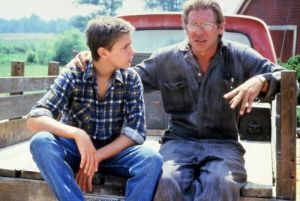
When the Amish child Samuel Lapp witnesses a policeman commit a murder in a train station bathroom, his life is instantly brought into the violent American/English world. This one incident for Samuel marks a transition in his life. Until this moment, all he had known was the world of his family, the Amish, on their farm. After John Book exiles himself to the family farm, he begins to have a great influence on the child. When Samuel's grandfather discovers him playing with Book's gun, the two have a discussion. Samuel reveals to his grandfather his thoughts on violence, which, now having directly experienced a great act of violence, greatly differ with his grandfather's. Samuel is shown to be sympathetic towards violence, which Grandfather Lapp and the Amish community greatly do not support. This scene is shot wonderfully, with the camera proxemics intimately keeping the two very close together, revealing their great affection for each other, regardless of their now different opinions. The gun lies on the table out of focus, showing how the violence will always be indirectly related to their personal history.


Mosquito Coast:

After Fox exiles his family to South America for his ideal Swiss Family Robinson-esque fantasy of living off the land while "helping the natives" begins to fall apart, Ford's son Charlie begins to break away from his support of his father. The scene in which Fox's machine begins to explode after Fox kills three men reveals this great diverge in trust and support. The flames within Fox's eye glasses show just how far off the deep end he has gone. The quick cut to Charlie backing slowly away and his disheveled appearance reveal his now fractured image of his father. He has surpassed his father in sanity and now he's stuck with him in South America.

Monday, February 28, 2011

Ruffino-Witness & Mosquito Coast


In both Witness and Mosquito Coast there are key transformation points for Samuel and Charlie, in which they show their new found knowledge and responsibilities. In Witness there is one scene that stuck out to me. The scene between Samuel and his grandfather. They are sitting together and discussing what makes a man good or bad. Samuel has begun to understand just what a life is worth and that is made clear by Samuel's response to his grandfather when he says I know what bad men do. Eli is less than thrilled with his grandsons new found knowledge.
Wishing only to protect him.

In Mosquito things are a little different but the message is essentially the same, a loss of innocence and metamorphosis as a result. Charlie loves and admires his father who to him is a genius and an incredible man. He has taken over the village trying to bring technology and a better life to the people who liveon the land he has purchased. When Allie's entire village is burned in front of his eyes, he not only loses his home but the remainder of his sanity. This is Charlies transformation point it is in this moment as his watches his fathers mental break that he realizes what he has to do. He is to take charge and lead his family and he does just that.

Kuebler-Witness/Mosquito Coast


It is well enough obvious that the scene in Witness between Samuel and his grandfather, Eli, that stands out is when the issue with the gun arises. As they sit there and discuss the meaning of a life and what makes a man good and evil, we see that Samuel has not taken his lessons lightly. Not only does he understand the measure and meaning of a life but also is beginning to learn the cost of a life and the worth of living. His grandfather is unhappy to say the least about this transformation that he is seeing in his namesake. Times seem to be changing and this new youth thinks that the answers are so plain and clear. They sit closely to each other in this scene to express just how severe a topic this is and keep the intensity of the scene in mind. This is a lesson that will be show by Harrison Ford later in the movie. Samuel sticks to his ways though and uses this life lesson to help himself along his path. Eli even seems to be moved by this experience and they both are safe.

In Mosquito Coast, things are not so cut and dry, nor are they as friendly and picturesque. Charlie and Allie are a much different breed of dominance of hierarchs and the change of the youth. Charlie idolizes his dad as a genius and a great man; Allie has more or less taken control of a village and with technology crafted a way to bring happiness and power to the land he purchased. When all goes awry we see Allie crumble and slip into a delusional state in which he is still in control. Charlie knows what he must do now and sees his fathers for the man he truly is and has been for quite some time. The son now must take the place of the father and lead the family after Allie’s dreams are burned to the ground quite literally along with any shred of his sanity.

Both of these youths are shown that what they held true and dear is no longer the truth and they must use this knowledge to grow into the men that they are to become. Innocence is no longer and option for these boys and from here out they must make decisions like a man.

Sunday, February 27, 2011

Ramon- Mosquito Coast and Witness


            I see the relationships between the patriarch and child in Witness and in Mosquito Coast as a very close one. In class, we spoke about the root of innocence meaning something like no knowledge. In Witness, Samuel Lapp loses his innocence when seeing the murder in the train station restroom. In Mosquito Coast, Charlie loses his innocence when he sees Allie murder the men inside of “Fat Boy.”
            With Samuel’s innocence deflated just as much as my blown out tire on the side on I-10, he has gained some personal sense of right and wrong from which to make his own decisions. As cliché as the conversation may have been, it sets up a great scene. Samuel Lapp sits on his grandfather’s lap for a heart to heart on the Sixth Commandment. However, before the meat of the issue, it is definitely on purpose that Samuel Lapp sits on his grandfather’s lap for the key point in the movie in terms of Samuel’s character development. From my own experiences as a child and in seeing the set up of this shot, a child sitting on an elder’s lap is a symbolic moment in an upbringing because the “patriarch” is briefly telling the child that he going to gain some sort of knowledge from the patriarch which will some day raise him above the patriarch. However, due to Samuel losing his innocence and gaining a sense of conviction, the message from his grandfather of “do not ever kill” does not come across to Samuel. Rather, Samuel retorts by saying “If the man is bad.”
           
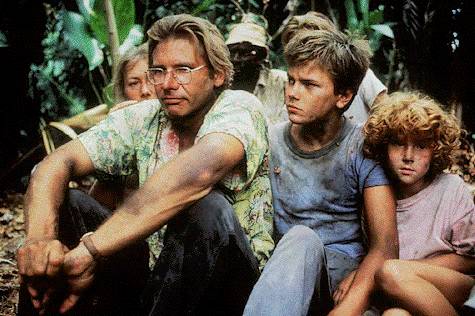
            In Mosquito Coast, Charlie comes to gaining knowledge over his father when the family wakes up and sees their community in ruin. In this screen shot below, Allie has a look on his face that says, “oh well.” On the other hand, Charlie has look that says, “you are the worst thing that has ever happened to me.” By looking at the pair’s body language, Allie is still leaning toward his civilization meaning that he isn’t finished with fulfilling his dream. On the other hand, Charlie is leaning away from his father and having nothing to do with his father’s desires. At this point Charlie has moved from idolizing his father to antagonizing him.
            Both Samuel and Charlie become more knowledgeable than their respective patriarchs because of experience through non-biased lenses. Eli Lapp has his own bias on murder due to his life in the Amish community. Allie Fox’s bias comes from his experience through the lens of corrupted American culture. Samuel and Charlie are able to critique their patriarch’s biases due to their own non-biased experiences; Samuel witnessing a murder himself and Charlie witnessing his father’s idealistic world come to a crumble along with its affect on his family. 

Bloo - Witness and Mosquito Coast


By witnessing a murder, Samuel's innocence is lost as Samuel tells his grandfather Eli that he is willing to kill a bad man, because he has witnessed ''the evil.'' Eli, who is portrayed as the wise and old traditional patriarch, takes over the role of the father figure by letting Samuel sitting on his lap and teaches him about the dangers of the gun and tells Samuel that the Amish believe that killing someone is wrong. He mentions to Samuel, '' the gun of the hand is for the taking of human life.'' The camera zooms to encompass an eyelevel close-up of Samuel looking into the worried expression of Eli. Eli asks him ''Will you kill?'' Samuel replies '' I would only kill the bad men.'' This shows how Samuel's Amish morals and values are corrupted. This does not fit into the morals and values of the Amish. Eli tries to explain that violence is not the answer to all of men's problems, but Samuel knows that this does not work in the ''real world'' since he has witnessed ''evil'' with his own eyes. Although, Samuel is very young, he has experienced and seen evil which his grandfather probably hasn't. In this particular scene, the dominant are Eli and Samuel which is passed over to the gun on the table which is slightly light emphasizing the importance of the discussion between the grandfather and the boy and that the gun is the reason why the two are emotionally distanced from each other.
'' I grew up with the belief that the world belonged to him and that everything he said was true.'' This is what Charlie Fox says about his father at the beginning of Mosquito Coast. This quote shows that Charlie idolized his father and that he believed in his father's dreams. Initially, Charlie obeyed his father without a question, but as the story develops Charlie comes to question his father's methods and loses his belief in him especially when Allie locks up the armed bandits in ''Fat Boy'' in an attempt to freeze them alive. The idea backfires when the men begin shooting in ''Fat Boy'' and as a result set themselves, along with the rest of the village in flames. We see Allie's face lightened up by the fire. His glasses reflect the flames which make him look like a mad men. Together with ''Fat Boy'', his sanity and utopian ideals goes up into flames as well. In the next shot, the dominant is again Allie who is sitting on the ground looking at his destroyed dream. His family sits behind him and Charlie sits close next to him, but he looks angry at his father. This shows that he questions his father. Even though, the proxemics are personal, there is a gap between father and son. Just like Samuel, Charlie has lost his innocence, because the person who he trusted and idolized destroyed his world and has put his family in danger. Charlie realizes he needs to grow up in order to save his family.

Frady - Mise en Scene Analysis of Witness and Mosquito Coast

In Witness, Samuel Lapp leaves the safe confines of the Amish community for the outside world, where he witnesses (hence the title) a police officer's murder. This event has forever altered the boy, for better or for worse. Because he is exposed to something horrible, something that likely no other Amish has seen (or for that matter, probably not many "English" either), Samuel can no longer be counted among the innocent. In this scene, his grandfather is attempting to impart the wisdom of their people regarding the taking of another person's life (it's not good). The Amish believe that there is no reason good enough to necessitate the taking of a human life. They see this issue strictly in black-and-white terms. Samuel, however, has transcended the need for this particular lesson, as he's already in the realm of shades of gray. He tells his grandfather that he would be willing to take a life of a bad man. When asked how he would distinguish the bad men from the good, Samuel replies that he can tell by their actions. And, seeing as how Samuel already has more experience with bad men doing bad things than his grandfather has, there seems to be little that the patriarch can say to this.
The lighting in this shot comes from behind the grandfather, leaving his face in shadow and illuminating Samuel's. This serves to illustrate Samuel's enlightened state. The dominant in the scene is likewise Samuel's face for the same reason.

In Mosquito Coast, much like Witness, the child surpasses the father in wisdom. Here we see Charlie with his father Allie. They are standing in darkness, Charlie's face lit dimly, yet brighter than Allie's. This is similar to the scene in Witness, but for different reasons. Charlie has always looked up to his father, believing him to be the smartest man in the world, as well as completely infallible. However, we begin to see Charlie doubting Allie's greatness right around the time Allie decides to drop everything and relocate the family to Mosquito Coast. When Doc tells Charlie that his father is a very dangerous man, we can see in Charlie's expression that he may agree with that sentiment. When Allie traps the three interlopers in his ice maker (which is the occasion for this scene), Charlie is definitely having doubts about his father's infallibility (and sanity). We can clearly see that he is frightened of his father, his gaze resting on Allie's extended finger, as if anticipating an eruption of crazy to spring forth.
Whereas in Witness, Samuel gains knowledge from an external source, in Mosquito Coast the knowledge Charlie gains comes from Allie. He sees what has become of his father, and now he knows what he shouldn't do, enabling him to gain autonomy and develop his own identity, separate from Allie.

Robert-Witness and Mosquito Coast

The scene in Witness where Samuel and his grandfather are talking about Book's gun is extremely important. While sitting on the bed his grandfather tells him about how one should never take the life of another. He is playing a patriarchal role, since Samuel's father is dead, and showing Samuel right from wrong. However, since Samuel has witnessed what violence can do he no longer sees things the way that his grandfather does. He agrees that he would never take the life of anyone unless they were a "bad man." He surpasses the knowledge of his grandfather because he has seen this sort of violence while his grandfather probably hasn't.

The first lines in Mosquito Coast are Charlie speaking about his father, "I grew up with the belief that the world belonged to him, and that everything he said was true." He has much respect for Allie, his father, and never argues with what he has to say. As the movie progresses, however, it's obvious that Charlie's trust in Allie wavers as his claims and actions become more outrageous. The scene in which Charlie's view of his father is forever changed is when they use the ice machine to kill three men who have come, unwelcome, into Allie's jungle town. The climax of this is scene is the ultimate explosion of the machine which destroys both Allie's prized invention as well as the village. Charlie looks at his father, as the fire eats up "Fat Boy," the ice machine, and no longer sees the father he had while they're were in America. In this scene Allie looks maniacal yelling out in anguish as his invention burns in the distance.

Saturday, February 26, 2011

Madere - Mosquito Coast and Witness

Both Mosquito Coast and Witness feature an element of the son in the film that has experiences that take their innocence and reverence for their patriarch and move them beyond their patriarch's knowledge. The beginning of each film features Samuel of Witness and Charlie of Mosquito Coast exhibiting their innocence and idolization of the patriarch of the film. Samuel's idolization can best be seen in the very beginning of the film, as he is traveling to the train station on the back of the horse and buggy, and sees the world around him with obvious admiration. For Charlie, the idolization and innocence is shown in the opening scene of the film while he is in the truck with his father, listening to his rants, while the voice-over proclaims his father as a "genius."
Samuel, however, loses his innocence early in the film when the inciting action, the murder of the police officer in the train station bathroom, takes it from him. In this scene, his loss of innocence is most accurately conveyed through the look in Samuel's eyes, which are conveying all of the conflicting feelings he has at the time: fear, confusion, uncertainty. In Samuel's eyes, you can see that he has witnessed something most people never see--especially the people in the Amish community in which he was raised.
After this scene, Samuel also begins to show a curiosity and affinity for the "English" world. This is most evident when he finds John Book's bullets, with obvious amazement, studies them. This is a scene he shares with his grandfather Eli (the patriarch of the film). With Samuel still close to him physically in the scene (and emotionally, as well), Eli warns Samuel of the dangers of the bullets and the "English" world of John Book and Philadelphia. This scene, with the proxemics of the characters, shows how Samuel is still close with his grandfather, but is also experiencing a loss of confidence and safety in the world he grew up in.
Charlie's loss of innocence and confidence in the world he once knew is, like Samuel's, also conveyed in a scene with his patriarch (his father, Allie). When the ice maker catches fire and blows up, Charlie observes his father become more concerned with the death of his invention than with the death of human beings. It is obvious in a look Charlie gives his father in this scene that what Charlie used to believe was genius is actually mental and emotional instability. Allie looks particularly insane in this scene, with most of his face drowned by the darkness and only the blaze of the fire reflected in his glasses. Charlie's face is also mostly covered in darkness, again except for his eyes, where the realization about his father's true nature is learned. The scene shows Charlie look over his shoulder at his father (with Allie just in the corner of the scene) and Charlie almost winces and pulls away from Allie. Charlie is also the dominant feature in the scene, which conveys to the audience that Charlie will have to defeat is father, save his family, and become the hero in the end.

Friday, February 25, 2011

Cutler: Witness/Mosquito Coast


In both Witness and Mosquito Coast, there is a special relationship between the patriarch and the young boy. Both children lose their innocence early in the film; Samuel in Witness sees a vicious murder in a train station and Charlie is subject to the bizarre and paranoid actions by his father. In Witness, the corrupt police officers come to the farm to kill Samuel and whoever else (they are later thwarted by John Book) and Eli nods at Samuel to run away. This shows not only the loss of innocence, but also show Eli's coming to terms with what has happened to their otherwise sheltered life. At first, Eli did not want Book or any of his "English" standards in their Amish community, but realizing that it would save Samuel's life, he agrees to house Book. When Book kills the "bad" men, Eli realizes that he really saved his family and in turn the lifestyle that they live by protecting them from outside world corruption and chaos. In Mosquito Coast, Charlie watches as the ice maker explodes and his father's reaction. He has lost his innocence completely when he realizes the mental instability of his father. His father took them to Central America to live freely and chase an unattainable utopia. Nothing goes according to plan and Allie goes crazy. Charlie is forced to see his father in a state where he is shown as weak and paranoid so he loses his innocence. In both scenes, the boys are dominant which directs the audience's attention to them to showcase their loss of innocence. Both films depict how young children are influenced not only by the patriarch in their family, but also by the outside world.

Torres - Witness and Mosquito Coast

The development of the child character is very similar in both Witness and Mosquito Coast. Both children are brought up in situations quite different from the world around them. Samuel is brought up in an Amish community that separates itself from city life. Charlie is raised in a household where the patriarch is an inventor with a disdain for American society, much unlike the typical American household. Both of these children start out as innocent but over the course of the film are forced to redefine their world view.

In Samuel's household Eli Ladd is the patriarch who does his best to make sure the Amish ways are followed. Unfortunately, after Samuel witnesses a murder in the city his innocence is lost and his worldview is changed. In the scene where Eli is trying to explain to Samuel that guns are unclean and not allowed in Amish society we are shown just how much his experience has changed him. The character proxemics are personal to show that this issue is important and a serious matter. Eli is the dominant, emphasizing his authority, but the gun on the table provides subsidiary contrast and emphasizes the damage that violence can do, even within this peaceful community. Samuel challenges his grandfather's insistence on nonviolence and is driven to get rid of "bad men," like those he witnessed murder another man. This goes against the Amish beliefs and emphasizes how drastic a change Samuel has experienced.

In the beginning of Mosquito Coast Charlie idolizes his father Allie Fox. He considers him a genius who can do no wrong. Eventually Charlie realizes that his father can, in fact, 'do wrong' as Allie's obsession with inventing and specifically gaining recognition escalates. While Allie and the others are attempting to deliver ice to an isolated tribe everything begins to go downhill: the ice melts before they get there, his villagers leave with the Reverend, and three unfriendly armed men follow them back to the village. Allie tries to dispose of them by freezing them, but unlike Allie's prediction, instead of lying down the men open fire, destroying the machine and the entire village by proxy. This is a huge miscalculation on Allie's part that shows just how different his mind works. While the machine is burning, Charlie gives Allie a look that distinctly tells the viewer that his perception of his father has changed. Although the two are usually shown in rather personal character proxemics, in this scene Charlie is so distanced from Allie that he is in a different frame altogether. Allie's eyes and open mouth are dominant in his frame, making him look particularly monstrous. Charlie's face is dominant in his frame, emphasizing his expression and disappointment in his father. This scene begins Charlie's gradual distancing from his father and his father's beliefs.

Gooch- Mosquito Coast and Witness

In both Witness and Mosquito Coast we see the young son or grandson lose his innocence and stray beyond what he has been taught and so long believed in. There comes a point where the child, who once lived and breathed revering his father, begins to see there is more he can believe in, more for him to consider before he dedicates his life to the ideals of his upbringing. In Witness, Samuel has been raised in the midst of the Amish people, and has been especially influenced by his grandfather, the quintessential Amish patriarch. His innocence has been easily preserved since he has not been exposed to the outside world and the corruption of the city. It is not until he ventures out into the city and sees the evil of greed and murder that he begins to question what his grandfather stands for. In Mosquito Coast, Charlie is constantly in awe of his father’s brilliance, and even when all others doubt him, he can still do no wrong in Charlie’s eyes. It is only after months of being worked to death and finally realizing that his father has put his whole family at risk and lost his morals, that Charlie begins to see that his father is very dangerous.

JanRubes.jpg

In the scene when Samuel sits on his grandfather’s lap, we can see how Samuel’s beliefs have been challenged by the evil he has seen. The character proxemics between the two is very intimate because his grandfather is desperately trying to maintain Samuel’s innocence and faith. And Samuel still loves his grandfather very much, so even though he timidly challenges what his grandfather is telling him he still remains close. His grandfather looks especially like the typical wise, old patriarch in this scene, the light reflecting off his white hair. The gun that lies in front of them on the table catches our eye, reminding us of what has caused Samuel to lose faith in the belief that it is never okay to hurt someone, even a bad man.

In the scene when the Fox family is watching their machine blow up, we see the beginning of Charlie’s disenchantment with his father. He once worked beside him without hesitation and stood up for him when his father was ridiculed, but now he questions all of that the night his father kills the three men with guns. First there is a close shot of his father’s face, the red flames glimmering off his glasses, giving him a devastating and crazed look. Then we see a close face shot of Charlie, who once stood right by his father, standing away from him now, looking scared and unsure. In the darkness, which shows the darkness of their story, we can almost only see Charlie’s eyes, but that is all we need to see in order to know what is going through his mind. He looks at his father in the darkness, seeing him cry for his invention, and realizes that his father’s vision has become more important that their lives and the lives of other people.