Americans and Irish alike have a strong emphasis on their family. This is shown very much so in The Devil’s Own. The O’Meara family gains a new member when Frankie McGuire is placed into their family the local judge. Much like Patriot Games, we have the IRA family and the American family side by side. The dynamics of IRA family is not so much prevalent in The Devil’s Own. Therefore, a scene I would like to focus on is the post-confirmation party when Tom O’Meara fully recognizes Frankie as a member of their Irish-American family. O’Meara does two things which Pakula purposefully puts high emphasis on in this scene. First, Frankie is asked to be part of a photo with O’Meara and his partner, Edwin Diaz. Some say a picture is worth a thousand words, and I agree. As a native New Orleanian, on numerous occasions we have had to evacuate for hurricanes. On our checklist of items to grab, the number one item is a photo album of the past 25 years starting with my parent’s wedding picture. If some day we lost out home to a natural disaster, we would still have our photos to look back upon and memories will never be forgotten. Second, Frankie is included in the traditional Irish dance by O’Meara. Frankie feels like he is back at home in Ireland, and buys into the O’Meara family lifestyle. By a simple dance, he is able to relax his mind of all the bad things he has done in his past and remember his heritage.
Showing posts with label Jeffrey Ramon. Show all posts
Thursday, April 14, 2011
Sunday, April 3, 2011
Ramon- Patriot Games
In Tom Massaro’s book “ Living Justice: Catholic Social Teaching in Action”, he indicates the nine key themes in Catholic Social Thought (CST). His claim is the importance of “family life.” In CST, family life is the central unit of society. The conditioning of persons is created and strengthened due to the family. Therefore, the future actions and world stability comes about due to the values bestowed upon offspring and values made clear to parental units by the actions of their offspring.
So, I would like to talk about Sean Miller’s relationship with his two families. The film is very much based on the hunter rather than the hunted. And in some respects, this film is more about Miller than about Jack Ryan. In Patriot Games, director Phillip Noyce puts a large emphasis on the importance of families, whether they are blood related or organizational. The difference between organizational families and blood families is a grey area in this film due to the actions of Sean Miller. Miller’s values come from his blood family and his organizational Family, the IRA. However, Miller breaks the barrier by killing off members of his organizational family in order to avenge the death of his younger brother (whom Jack Ryan killed during the failed assassination of the Royal Family). This leads into another point of Sean Miller’s ideals/Noyce’s debated message. Sean Miller made an attempt to assassinate the Royal Family, the symbol for the nation’s values, and he paid no regard to the lives of his IRA family when chasing after Jack Ryan. It seems to be that Sean Miller has some sort of edge against organizational families because they get in the way of what makes “him” which is the attachment to his blood family. My claim made about Noyce’s message, mediated through families in the plot, is such. Noyce believes that organizational families are detrimental to the individual’s values and bad for the blood family. From Jack Ryan’s relationship with the CIA to Sean Miller’s destruction of his organizational family, organizational families destroy the central unity of society.
Sunday, February 27, 2011
Ramon- Mosquito Coast and Witness
I see the relationships between the patriarch and child in Witness and in Mosquito Coast as a very close one. In class, we spoke about the root of innocence meaning something like no knowledge. In Witness, Samuel Lapp loses his innocence when seeing the murder in the train station restroom. In Mosquito Coast, Charlie loses his innocence when he sees Allie murder the men inside of “Fat Boy.”
With Samuel’s innocence deflated just as much as my blown out tire on the side on I-10, he has gained some personal sense of right and wrong from which to make his own decisions. As cliché as the conversation may have been, it sets up a great scene. Samuel Lapp sits on his grandfather’s lap for a heart to heart on the Sixth Commandment. However, before the meat of the issue, it is definitely on purpose that Samuel Lapp sits on his grandfather’s lap for the key point in the movie in terms of Samuel’s character development. From my own experiences as a child and in seeing the set up of this shot, a child sitting on an elder’s lap is a symbolic moment in an upbringing because the “patriarch” is briefly telling the child that he going to gain some sort of knowledge from the patriarch which will some day raise him above the patriarch. However, due to Samuel losing his innocence and gaining a sense of conviction, the message from his grandfather of “do not ever kill” does not come across to Samuel. Rather, Samuel retorts by saying “If the man is bad.”
In Mosquito Coast, Charlie comes to gaining knowledge over his father when the family wakes up and sees their community in ruin. In this screen shot below, Allie has a look on his face that says, “oh well.” On the other hand, Charlie has look that says, “you are the worst thing that has ever happened to me.” By looking at the pair’s body language, Allie is still leaning toward his civilization meaning that he isn’t finished with fulfilling his dream. On the other hand, Charlie is leaning away from his father and having nothing to do with his father’s desires. At this point Charlie has moved from idolizing his father to antagonizing him.
Both Samuel and Charlie become more knowledgeable than their respective patriarchs because of experience through non-biased lenses. Eli Lapp has his own bias on murder due to his life in the Amish community. Allie Fox’s bias comes from his experience through the lens of corrupted American culture. Samuel and Charlie are able to critique their patriarch’s biases due to their own non-biased experiences; Samuel witnessing a murder himself and Charlie witnessing his father’s idealistic world come to a crumble along with its affect on his family.
Saturday, February 12, 2011
Ramon-Blade Runner Lovey Dovey
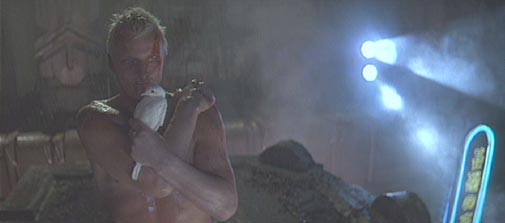
I immediately view this final scene through a religious symbolic lens. The dove’s symbolic meaning is threefold. One, it is a symbol of peace in the story of Noah’s Ark. Throughout the movie, Deckard and Roy are battling with each other replicant vs. human. Roy saves Deckard; thus, he makes his peace with Deckard. I see that Roy’s termination is incomplete without a sense of making peace. When he does make peace, he is able to release that peace (dove) to the world/humanity (Deckard). This also answers the question of why Roy saves Deckard.
At the same time, it should be asked why the “animalistic” nature of Roy is turned to more a more humanistic nature. The best solution to this also can be answered through another symbolic meaning of the dove, which is purity. Though replicants are “animalistic”, they also have a sense of purity that humans do not in this film. The humans here are seen as the “bad guys” due to their thought of owning replicants for colonization. Thus, the replicants have a sense of purity that the humans do not have.
The third symbolic element of the dove is a combination of purity and peace. These two elements of ideal human nature lead to the definition of a soul. Biblically, we see on many occasions the giving up of the soul to the heavens. From Mary’s Assumption of body and soul, and from Jesus’ final words on the cross, we see figures who give their soul up to God for the greater purpose of the world. I will agree with the producers of the film in their addition of Rachael and Deckard’s escape to the new colony. Roy gave up his soul so that the face of humanity (Deckard) is able to begin anew with Rachael.
Saturday, January 29, 2011
Ramon- Temple of Doom
The difference in belief and believing is a great one. It is one thing for someone to be aware of a certain belief a group has, but believing is the key to success in a journey. To make reference to sport, a team must not only execute a system of play the their coach has set for them, but they must also genuine belief in that system for a sense of confidence among the members an a cohesive unit to become truly successful. That is directly equated to the apotheosis Indiana Jones goes through in Temple of Doom. In the beginning of Act II, Shorty is told by Indiana that the villagers merely told him a ghost story about the stone’s importance to the village. At this point, Indiana is a pure mercenary (like we see in the bar in Episode IV: New Hope). Jumping to (pun) the scene on the bridge, Indiana emerges from a state of belief to believing in the power of the stones.
In a hermeneutic arc, one goes through constant states of refection and experience. Not all of these experiences come from “good.” Here Indiana’s believing comes from his journey to the underworld, where “evil” reigns. It is through our experiences with ‘evil” that we grow to a sense of “good.” Once Indiana experiences the underworld, he is drawn to the side of “good” for which he must fight to protect. Indiana uses the divine powers of “good” as a catalyst to overcome Mola Ram, thus overcoming “evil.” In the hero’s journey, he is sent to bring back an item from the underworld to the people he is a part of or sent to be a part of. The hero’s journey would not be complete if Indiana would have taken the stone to a museum.
Sunday, January 23, 2011
Ramon- Who is Leia?
First, what is the goddess and what is the temptress? In relation to our Darth and Obi Wan discussion, there is a light and dark side to Leia’s character unrealized to her because these traits are formed due to the actions of Luke and Han. The goddess is or light or our spiritual, where the hero is driven by her presence and the benefit for the greater good. On the other hand, the temptress drives or distracts the hero in his journey. Leia is not to such an extreme as Calypso is to Odysseus, but to the hero (namely Luke) she is the prize. In A New Hope, it can be easy to label Princess Leia as the Goddess to Han and the temptress to Luke. In Episode V: The Empire Strikes Back, the relationship between Han is that of indifference. We see that right off the bat with them bickering in the corridor. However, Luke is still obsessed with her. Once before I said that Leia was the goddess to Han and Luke, but in terms of Episode V, she is the erotic temptation that is driving the heroes to succeed. To my remembrance, there was no happy ending in this film. The heroes are separated, with our civic hero in Han being held captive by the opposition.
Playing devil’s advocate here with myself, the moment where Luke leaves his training to go save his friends. At this moment, Leia is changed in Luke’s mind from temptress to goddess, or at least that is information we can imply by his tone of voice and assertiveness. Leia character, since it relies so much upon the actions of Luke and Han towards her, is once that is very difficult to come to any sort on conclusion on what her role in the films are.
Just for some humor. Some of you may have already seen this terrible spoof, but its always worthy of a few chuckles.
Subscribe to:
Posts (Atom)