Showing posts with label Temple of Doom. Show all posts

Friday, February 4, 2011

Madere - Last Crusade


This scene, taken from the end of Indiana Jones and the Last Crusade is indicative that Indiana has reached the final stage 0f the knight's quest--that of the Grail Knight. Although each stage of the knight's quest is highlighted individually in each Indiana Jones movie--the Mercenary Knight in Temple of Doom, the Indentured Knight in Raiders of the Lost Ark, and of course the Grail Knight in Last Crusade--scenes that portray Indiana in each of these roles all appear in the final movie.
The scene that shows Indiana Jones as a Mercenary Knight in Last Crusade happens at the very beginning of the movie when he discovers the cross of Coronado in a cave in Utah. Despite the fact that the cross was found by someone else (and thus belongs to him), and despite Indiana's righteous quote, "It belongs in a museum," it is clear from the look on Indy's face that he's somewhat starstruck by the cross. While it is clear that he steals the cross with the intent of having displayed in museum, there is also an undercurrent of perhaps wanting to be the person who famously recovered it. The scene immediately following this one also sets the story for Indiana's overall "anything goes" Mercenary Knight attitude in Temple of Doom, as he is betrayed, and this squashes any intent he had to go on his quest for any higher purpose than money and glory.
The scene in Last Crusade that shows Indiana Jones as an Indentured Knight are the scenes where Indy agrees to go on the journey to find his father at Donovan's request and on Donovan's dime. It is clear that he is only on the quest to serve one end--to find his father--and, unbeknownst to him, becomes Donovan's puppet in his quest to find the Grail and, ultimately, eternal life and power.
Indiana's transition into Grail Knight in Last Crusade begins with the scenes conquering the three tasks that you must pass in order to prove yourself worthy of finding the Grail. These scenes show Indiana's new found faith and belief in God and the Grail, as well as his exhibiting the mythic characteristics needed for a Grail Knight. His transition is complete when, in the second-to-last scene of the movie, he gives up reaching for the Grail (and eternal life, fortune, and glory) in order to save his life and the life of his comrades. This scene proves that he has conquered his demons and his love of material things and grasped onto a larger purpose.

Sunday, January 30, 2011

Ruffino-Temple of Doom

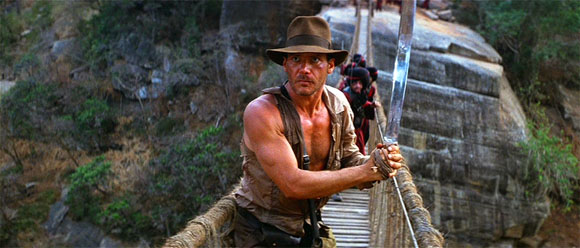
Indiana Jones begins Temple of doom with only two things on his mind, fortune and glory. Indie is then asked to retrieve a valuable stone which he does thinking only of what this stone could do for him, not concerning himself with the lively-hood of the village. Indiana does not believe in the stones power at first but he then begins to believe after he feels the power full force this new faith is what will ultimately save him on the rope bridge.

As he is dangling from the bridge the only thing that could save him was this new found faith in the stones power. He put his belief in the stone and it did not betray him Indie was saved and he was a changed man who now understood why the stone was so important to the villagers and that it truly belonged to them.

In conclusion to Indies journey he returns the stone and children to the villagers as requested. He is then asked why he decided tor return the stone instead of putting it in a museum as originally planed. His reply shows how he has progressed and how he thought of others and not just himself. His transformation was great but not yet over.

HENRY: TEMPLE OF DOOM


In order for some people to truly believe in something, it must be very tangible. For Indiana fortune and glory are two very tangible things, but beliefs in old customs and stories do not add up to fourtune and glory for him. He refuses to understand how the lost stones bring safety to the village, but he does understand that the retreiving of those stones can possibly bring him fortune. From the time Indiana Jones entered the village, he did not believe in their tales or beliefs in regards to the stones that were stolen, yet he embarks on his journey in hopes of a substantial reward. But as his journey continues, he begins to transform from a merchanary knight. Now his loyolaty belongs to the people of Shieva and their glory. The scene on the rope bridge serves as an apotheosis for Indiana Jones because he gains a higher level of understanding for the people of Shieva. He starts to understand that the stone serves a higher purpose when in the village, rather than in a museum. Now, instead of endangering his life for fortune his does so for the people. On the bridge he put his life on the line, and he knows that the only way to survive would be to believe in the stones powers. He does believe, whcihc is why he survives and he does not betray the people of the village. He returns to the village with the chhildren and the stone and hands it over to the chief. When asked by Willie on why he returned it, his mentality for the moment seemed to shift from fortune and glory to one that puts others above self.

Roberts-Temple of Doom

In the beginning Indiana is approached by a small village for help when one of their shrine stones goes missing. They believe that he was sent to them from Shiva to return it to them. Indiana is apprehensive and faithless until he realizes that the stone may be a Sankara stone which if retrieved would promise fortune and glory. His journey for the stone is not to help the village but to advance himself. Fast forward to the end. Indiana has drunk the blood of Kali, been rescued by Shorty, and now the original trio are trying to make their escape across a flimsy rope bridge. This is where Indiana's Apotheosis occurs.
Originally doubting the faith of the villagers from before Indiana now invokes the power of Shiva in order to defeat the villain. He no longer seems worried about his original goal of fortune and glory and instead threatens to dispose of the stones when Willie and Shorty's lives are threatened. Finally he is not upset when two of the three stones are lost to the crocodiles below. He has the one that was needed for the village's shrine. He returns it to the village and concludes his journey.

Cutler: Temple of Doom


In Indiana Jones and the Temple of Doom, the scene on the rope bridge is both an apotheosis for Indiana Jones and an initiation into a higher form of behavior. Before the bridge scene, Indiana was just in it for money and glory, living up to his categorization of the mercenary knight. However, on the bridge, he lets go of his opinion that the stone was just a ghost story. When he is stuck on the bridge with Short Round and the stones after escaping the Temple of Doom, his enemies have him surrounded. He decides to cut the bridge, sending the other men into their watery grave, and saving himself, Short Round and Willie. It seemed like a crazy action as he said "prepare to meet Kali in HELL!" but he did it when he realizes he can't act like a mercenary hero anymore.
He used the powers of the stones to go through an apotheosis into a higher form of behavior, both literally and religiously. The stones were a religion for the people of the village and he used them to connect with a higher being to save the stones and kill the antagonists. He also went through an initiation into a higher form of behavior because he no longer acted selfishly and for the fortune and the glory, but rather for the sake of the village and Willie.
When the climatic rope bridge scene ends, we see Indy in an entirely new way. He no longer wants money, but uses his skills as an archeologist in a good way to better more people.

Massiha Temple of Doom


Indiana goes from a willing mercenary to a village hero. In the beginning of Temple of Doom, all he wants his fortune and glory. When he’s first told in the village about the stone, he dismisses it as an old ghost story. Shorty tries to warn him that he will get killed if he goes, but Indiana’s fortune and glory motto holds true and lures him into the adventure. He just doesn’t realize how much crap he got himself into. You’d think after he almost got impaled to death and was chased after a creepy shaman and a couple hundred Thuggees that he would quit with the fortune and glory BS. But, it takes Indy being under the Kali influence, witnessing a sacrifice, and seeing child slaves, to finally realize this stuffs no joke. Fast forward to Indiana being on the rope bridge surrounded by Thuggee lead by their creepy priest leader. It’s at that moment he you realize he has to make a decision. As he’s dangling from the rope bridge he just cut, the creepy shaman decides to a pull used car saleman line and say just give me the stone and I’ll spare you guys cliché bad guy line. Indiana pretty much rejects him and at the point we don’t know if it’s because he wants the stones for himself or for the village. The shaman then gets angry as most rejected people do and tries to steal the stones. Mind you they are dangling over a crocodile infested river. One thing leads to another and Indiana starts a chant. He tells the shaman that he betrayed Shiva and that this is revenge. He starts chanting faster and thus ignites the stone. The shaman refusing to let the stone drop to the crocodiles, reaches out for the stone and consequently burns his hands and plummets down to the crocodiles, but not before Indiana can catch the

stone. It’s not til everyone is waiting for Indiana to climb up that we notice the change. He hoists the stone up first and that’s when we realize it’s not about the fortune and glory. It’s about doing the right thing. He realizes that the village needs it and that it does hold power. I guess not all things belong in a museum.

Frady - Apotheosis on the Bridge

In the events leading up to the scene on the bridge, Indy has begun to exhibit more and more compassion and selflessness. However, these traits were tempered with his drive for fortune and glory. On the bridge, however, Indy seems free of his selfish motives, willing to drop the Shankara stones into the crocodile-infested water below.
When his plan to use the stones as a hostage falls through, and Indy finds himself playing tug-of-war with Mola Ram while they dangle precariously from the severed rope bridge, he does something unexpected. Somehow, Indy channels the power of Shiva, chanting and making the stones grow hot enough to catch fire and burn through his satchel. It's not certain where this sudden arcane knowledge comes from, but it serves the purpose of implying Indy's apotheosis. Indy exhibits the requisite attributes: divine knowledge, compassion, and bliss. He now fully understands the spiritual significance (power) of the stones, and that it transcends their monetary significance.

Saturday, January 29, 2011

Lazo - Temple of Doom

Indiana Jones and the Temple of Doom features a different Indy than the chronologically later films. In Temple, Indy plays the role of the Mercenary Knight, not all that unlike Han Solo from Star Wars. His chief concern is money, or "fortune and glory." He holds little interest in the cultural or historical value of what he finds, as indicated by his dealings with the gangster Lao Che or telling Short Round that the power of the village's stone was a "ghost story."


In Pankot Palace, Indy descends into an underworld and witnesses the power of the Sankara Stones firsthand by the evil Mola Ram. Following his escape , he is cornered on a rope bridge above a river full of crocodiles. Indy cuts the bridge and fights Mola Ram, both hanging on for their lives. Here, he uses an incantation that makes the stones burn, Mola Ram falls, and Indy saves the village's stone. This is Indy's apotheosis. He now believes in the power and history of the relics. He understands the importance of the stone, not only in itself, but also the significance and value to the village. Fortune and glory become insignificant in comparison, and he is no longer simply a Mercenary Knight.